Script for November 25, 2006
Intro
DEAN OPENING REMARKS
GOOD MORNING, AND
WELCOME TO THE RETIREMENT SHOW…
THIS IS DEAN
GAMBRELL AND
THIS IS THE PROGRAM
IS DEDICATED TO HELPING YOU
PLAN FOR, ACHIEVE,
AND MAINTAIN YOUR FINANCIAL INDEPENDENCE.
AND MAKE
SMART DECISIONS WITH YOUR SERIOUS MONEY.
REMINDERS –
STREAMING LIVE
www.wapi1070.com
THIS MORNING WE’RE GOING TO DISCUSS
RETIREMENT PLANNING AND A BIG PROBLEM THAT MOST PEOPLE FACE
IN PLANNING FOR THEIR RETIREMENT ….BUT AND ALMOST NONE ARE AWARE OF
IT…
IN FACT MANY PEOPLE ARE RELYING ON
ADVICE FROM ADVISORS WHO AREN’T AWARE OF IT.
THE PROBLEM IS PEOPLE RELY ON
INACCURATE ASSUMPTIONS ABOUT RATES OF RETURN…
OUR GUEST THIS MORNING CALLS ONE
ASPECT OF THIS THE “FLAW OF AVERAGES”
HIS NAME IS MR. JIM OTAR, HE’S A
CERTIFIED FINANCIAL PLANNER WITH AN ENGINEERING BACKGROUND, IN FACT HE HAS HIS
MASTERS DEGREE IN ENGINEERING, HAS WRITTEN TWO BOOKS, AUTHORED EXTENSIVE
RESEARCH AND PAPERS, AND NUMEROUS PRESENTATION S TO PRESTIGIOUS GROUPS ABOUT
THIS TOPIC …REFER TO BIOGRAPHY
GOOD MORNING JIM & WELCOME TO THE
SHOW
Jim,
people are often presented with, rely on, and make important decisions based
on, investment information that that talks about “average rate of
return”.. a broker or online mutual fund site may tell someone that the
average rate of return of an investment has been 8% or 12%.... What is the
problem with relying on that information?
Why
do you call this the “flaw of averages”?
FLAW
OF AVERAGES:
Before
I went into the financial planning business, my wife and I had a financial
planner. During our first meeting with him in 1991, he asked us many questions
and he tried to find out about us as much as possible. That is good, because
before he can give us advice, he should get to know us.
In
our next meeting, he came with a retirement plan. This was great; it showed that
we would have gazillion dollars for our retirement. Both my wife and I felt
great.
However,
one thing he said struck me as very strange: he said something like “well,
historically a portfolio of this type should grow ON THE AVERAGE by 12% per year
over the long term. And then he used a portfolio growth rate of 10% going
forward, just to be on the safe side.
As
an engineer, that was the strangest thing I could hear, because when you design
something you don’t design it for the AVERAGE, you design for ADVERSE events.
Let me give you an example: the average
wind speed on an average day in
Birmingham may be 5 miles per hour. However, when you look at the glass walls at
the front entrance of the Birmingham Museum of Art, I have no doubt that the
civil engineers designed these glass walls to withstand storms with wind speeds
higher than the average 5 miles per hour.
We
can use the same analogy for retirement planning, if you use the average
historic portfolio growth rates, the chances are, your portfolio will run out of
money a lot sooner than you think. If you want to design your portfolio to
withstand adverse market conditions, you must not use “averages”.
Unfortunately,
to this day, far too many advisors still use the average growth rates when they
make retirement projections. To put it in perspective, if you assume an 8%
average portfolio growth rate and you are taking out $6,000 each year indexed
fully to inflation from a portfolio worth $100,000, then there is 88% chance
based on market history that your portfolio will run out of money sooner than
your projection. We are talking about huge failure rates, 80 percent, and 90
percent. Yet the financial industry still keeps making big promises and offers
little substance, except a handful of advisors and a few insurance companies.
Are
knowing mathematical “average rates of return” on investments of any
value?
So
the sequence of return is more important than the average?
AVERAGE
RATES OF RETURN, SEQUENCE OF RETURNS:
When
we are talking about retirement planning, average rates of return has pretty
well no value. Averages are for a population of numbers, you cannot use averages
for an individual. If you are lucky, you may catch a 20-year secular bull
market, then your average portfolio growth will be 15%, give or take. That is
wonderful; you can’t do any wrong. But, if you happen to catch a secular
sideways trend for 18 to 20 years, like we had between 1900 and 1920, or between
1966 and 1982, then average portfolio growth will be 2% to 3%, you will likely
run out of money during your retirement.
If
you are using a standard retirement calculator, you need to use adverse – not
average -growth rates, just to make sure that your portfolio can survive.
And
the adverse growth rates depends on how much money you are taking out of your
portfolio: for example if you take out 6% out of your portfolio, then use 4%
growth rate in a retirement calculator. This will give you a projection which
has about 90% survival rate, based on market history. Or even better, you can go
to my website and download my calculator which is based on market history and it
will do the all calculations for you.
We
are warned that “Past Performance cannot be relied upon to predict future”
– is past performance of no use in planning?
PAST
PERFORMANCE:
My
purpose of using the past performance is not to predict the future, but to give
my client the range of outcomes that happened in the last 106 years, which
covers most imaginable market events. I don’t care if 1982 was a better year
than 1956, but when I look at the whole envelope of outcomes since 1900 it gives
me a lot of information. So, what I am presenting to my client is not a
forecast, but a snapshot of historic outcomes.
Then
the client decides for himself when to retire, how much more to save, how much
can he spend after retirement and all that.
One
of the most important things in retirement planning is not to make a forecast
based on ridiculous assumptions. When I prepare a retirement plan for my client,
I make no assumptions and I make no forecast: All I do is take clients financial
information, plug that into my retirement calculator, and then I show my client
what would have happened based on 106 years of market history. I show him or her
the lucky and unlucky scenarios, and everything in between.
What
are Monte Carlo Simulations? Do they help? What are the flaws of Monte Carlo?
MONTE
CARLO SIMULATIONS:
Monte
Carlo simulations are the new fad. You see, the financial industry must keep
inventing new things all the time to keep clients coming to them.
Several
years ago, when I realized that one should not use average growth rates, I
looked at Monte Carlo simulations. I knew about this technique in my engineering
years, so it was not difficult for me to develop some interesting models. Later
on, as I looked at it closer when I was writing my book “High Expectations and
False Dreams – One Hundred Years of Market History Applied to Retirement
Planning”, I discovered many of the weaknesses of Monte Carlo.
Its
main flaw is that it generates random outcomes. In real life, markets are random
in the short term, but they are cyclical in the medium term, and trending in the
long term. So, basically, the glove does not fit the hand…
I
was sorry to see that NASD recently approved use of Monte Carlo simulations for
retirement planning. The projections that the Monte Carlo simulators generate
are usually too optimistic.
Since
my first brush with Monte Carlo simulators, I developed a retirement calculator
based on actual market history.
Are
we talking about “probabilities” of success?
When
it comes to retirement planning, yes, we are definitely talking about minimizing
the probability of portfolio depletion or portfolio going to zero. In retirement
portfolios, the two most important factors are how lucky you are with respect to
long term market trends, and the withdrawal rate. If the withdrawal rate near
age 65 is higher than 4% of the portfolio, then the probability of failure is
high. If you are 65 years of age and retiring, have $500,000 for retirement, you
should take out more than $20,000 each year, indexed to CPI for the rest of your
life. If you catch a good secular bull market then the story changes of course,
then you can take out more. But you should not count on luck during retirement.
I
sure have listeners who have or will have millions of dollars to fund their
retirement. For those there is perhaps less pressure to plan wisely because
they have so much they think they can avoid or withstand most risks.
On
the other end we have listeners who will have nothing but social security….
Their only option is to keep working as long as possible and hang on to a
frugal lifestyle.
But
most of our listeners are in between these extremes and their investment
planning is very important to their future lifestyle. People want simple
answers – but planning is very complex.
What
kind of Advanced Retirement Planning do you recommend?
ADVANCED
RETIREMENT PLANNING:
Dean,
let me tell you one thing; advanced retirement planning is advanced only for the
advisor. Let me make it lot easier for the average folk: Here are two simple
tips I’ll share with our listeners:
First,
figure out how much income you need after retirement. That is one side of the
equation. Then add up all the income you expect from pensions, social security,
rental income, whatever else. That is the other side of the equation. What is
your shortfall? If you don’t have a shortfall you don’t need to worry about
retirement.
If
you do have a shortfall then ask the next question: If you were to take all your
retirement savings and buy yourself a life annuity, or a variable annuity with
guaranteed payments for life, would the monthly payments from this meet all your
shortfall? The answer is either yes or no.
If
the answer is no, then you do not have the financial capacity to generate income
from an investment portfolio, because in most likelihood your investment
portfolio will expire before you do.
So
tip #1 is this: If a life annuity (or a variable annuity with life guarantee)
cannot create the income that I need then an investment portfolio is a no-no,
there is not enough assets to weather the adverse markets.
This
brings us to tip number 2: At age 65, if you have at least 25 times the income
you need in the your first year of retirement, then you can probably finance
your retirement through an investment portfolio.
Dean,
I have some examples if you want.
Let’s
work through a couple of examples…..(use outline example case studies)
EXAMPLES
FOR LIFELONG INCOME:
For
example, say a client has $1,000,000. He is 65 years old and just retiring, and
he wants his portfolio last until 95. He wants to take out
$60,000 a year from his portfolio. The question is: Does he have enough
savings? First thing to do is; get an annuity quote: I used a life annuity with
3% annual indexed payments. It pays, $55,000/year for life. If he were to cut
back his expenses a bit, then he can have a life long guaranteed income. That is
fine.
Should
he invest his money, perhaps he can then take out $60,000 annually and maybe
he’ll get lucky.
Well
based on market history, depending on his portfolio expenses, there is about 88%
chance that he will run out of money before age 95. So the odds are against this
client, he should stick with the annuity.
Let
me give you another example: If you have at least 25 times what you need in the
first year of retirement, then you can finance your retirement through an
investment portfolio. So, if you shortfall is $60,000 then multiply it with 25,
which is $1.5 million. If you have more than $1.5 million, then you can the
annuity route and finance your retirement with your investments. Of course these
are just some rule of thumb numbers, each specific case is different.
Assumptions
for real life Financial Planning
ASSUMPTION
IN REAL LIFE RETIREMENT PLANNING:
The
real life retirement planning involves a number of different points:
Time
value of fluctuations
TIME
VALUE OF FLUCTUATIONS
is the combined losses in a distribution portfolio due to factors beyond our
control. They are the “friction losses” of a distribution portfolio. There
are three big factors that shortens the portfolio life: The Luck Factor, Reverse
Dollar Cost Averaging and Inflation
Luck
Factor:
The luck factor refers to the timing of the start of your
retirement. When you look at the market history, we see that there are long term
trends that can last as long as 20 years. The most recent long-term bullish
trend was between 1982 and 1999. Before then, between 1966 and 1982, there was a
sideways trend.
If
your retirement coincides with the start of a long-term bullish trend, then in
all likelihood, you will have a lifelong income from your investment portfolio.
If you retire any other time period, then the chances are your portfolio will
deplete between 10 years and 20 years, depending on your withdrawal rate.
The
sequence of returns right after your retirement has a huge effect on the
portfolio longevity. That is called the luck factor.
Market
Cycles and Trends
MARKET
TRENDS AND CYCLES:
When
we look at the market history, we observe that markets move in long- term
trends. We call these “secular” trends, of “megatrends” or
“generational “ trends. Some secular trends lasted 8 years like the roaring twenties,
some last 18 to 20 years.
Then
within these secular trends there are cyclical trends. These are generally the 4
year market cycles, or business cycles. They are the building blocks of the
secular trends.
The
next level of market movements is called the seasonality.
The
shortest trends are the random fluctuations, which can last from a few minutes
to a few months.
The
secular trends create the luck factor, which can cut the portfolio life by as
much as 60%.
The
cyclical trends create the reverse dollar cost averaging effect, which can also
cut the portfolio life by as much as 50%.
The
seasonality and random fluctuations have no significant effect on portfolio
longevity.
Reverse
DCA
REVERSE
DOLLAR COST AVERAGING:
Many
listeners may be familiar with the dollar cost averaging. You decide to invest a
specific amount of money at specific intervals. Like you add each month $200 to
your portfolio automatically.
Over
the long term, your average cost
of investments will be less than the average cost of the investment, because
your money buy more shares at dips and less number of shares on tops. That works
great for you during the accumulation stage.
Reverse
dollar cost averaging is exactly the opposite: What happens when you retire is,
you need to withdraw money from your investment regularly, perhaps every month.
If you are taking out this money from a fluctuating investment, every time you
take out money at a dip, this creates a permanent loss in the portfolio. That is
the effect of reverse dollar cost averaging. It is bad for retirement
portfolios.
The
remedy is very simple: the withdrawals should be made only from non-fluctuating
investments, like money market funds. Never take your regular withdrawals from
equity funds, balanced funds, even aggressive bond funds.
If
you follow this rule, and the portfolio-rebalancing rule, you can minimize, or
even almost eliminate the effect of reverse dollar cost averaging.
Rebalancing
– Optimum guidelines?
REBALANCING
GUIDELINES:
Let’s
say your optimum asset mix is 40% equity 60% bonds. Over time the value of these
investments will change. Say at the end of the year you find that your asset mix
has shifted to 46% equity and 54% bonds. You need to bring your asset mix back
to 40/60 mix. So you sell some equities and buy bonds and you are back to 40/60.
In
my research, I found out that for accumulation portfolios, where you might have
for example 65% stocks and 35%, it is best to rebalance when the asset mix
deviates by more than 4%.
However,
in retirement portfolios, where you take money out, it is a little bit more
complicated. The optimum rebalancing depends on your withdrawal rate. If you are
taking out over 5%, then you should rebalance once a year. But if you are
withdrawing less than 5% it is better to rebalance once every four years. That
will give you a longer portfolio life, or a larger portfolio value.
So,
for the retired folks out there who are lucky enough to take out only 3 or 4
percent from their investments, rebalancing once every four years on the
Presidential election year, may work better. If you run my calculator, it tells
you what type of rebalancing is best for you.
Asset
Allocation –decision process
ASSET
ALLOCATION:
One
thing about asset allocation: it is important , but it is far less important
than the financial industry wants you to believe. The financial industry will
tell you that asset allocation contributes over 90% to the differences in
portfolios success. Well,; the folks who did that study looked at the largest
pension funds, all in secular bullish markets, and ignored the luck factor
entirely. This study does not apply to individual portfolios, it applies only to
pension funds, and I don’t need to tell you the miserable state that many of
those pension funds are in. If you feed garbage knowledge to an investment,,
you’ll end up mostly with manure.
The
luck factor influences the portfolio longevity by well over 50%, asset
allocation only by 25% maximum. Of course these numbers depend on the withdrawal
rate.
The
decision for asset allocation is simple: It takes two steps: Step number one:
what asset mix gives my client the most dollars in the portfolio, or the longest
portfolio life. Step number two what is the tolerable asset mix for this client.
In
my retirement calculator, you can push the “optimize” button, and the
program tells you the tolerable and the optimum asset mix based on 106 years of
market history.
Sustainable
withdrawal rates
SUSTAINABLE
WITHDRAWAL RATES:
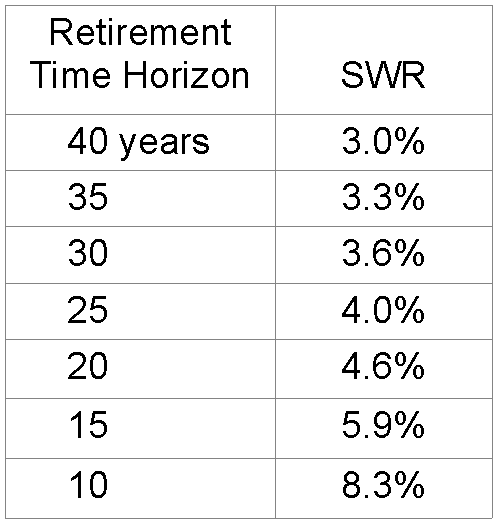
SWR
is the maximum amount of money you can withdraw periodically from your
investment portfolio without the probability of depleting the capital before a
predetermined time horizon. It is based on market history
SUMMARY:
WRAP
UP:
The
most important decision in retirement planning is not the asset mix, not what
stocks or mutual funds to buy, not the choice of small cap / large cap, domestic
/ foreign, emerging / developing.
The
most important decision is to figure out whether you have the financial capacity
to be invested at all. If at the age of 65, you have retirement assets less than
25 times your annual income needs, then resist the temptation, don’t look at
stocks or bonds, look for life annuity. If your savings are more than 25 or 30
times of your annual income needs, then you have the financial capacity for
investments. Don’t let any advisor tell you otherwise.
JIM, IF SOMEONE WANTS TO CONTACT YOU
DIRECTLY, WHAT IS THE BEST WAY
The best way of contacting me is sending me
an email through my website www.retirementoptimizer.com
Please keep in mind; I cannot give personal financial advice but can answer only questions of general nature.